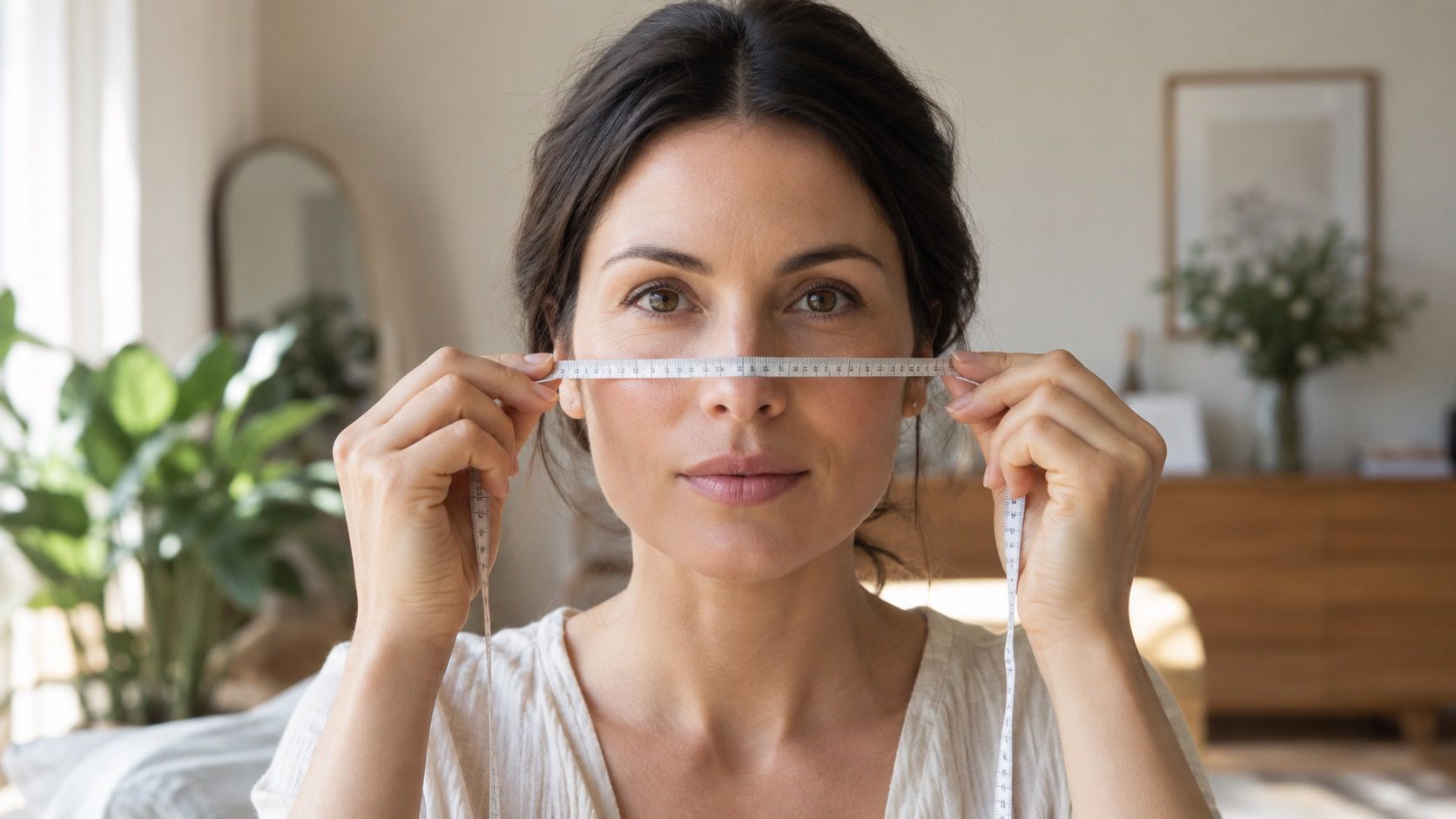
Face-shape measurements are most helpful when they show how your forehead, cheekbones, jaw, and overall length relate to one another. You do not need to chase a mathematically exact answer. With a soft tape measure, a mirror, and a relaxed expression, you can collect a few consistent numbers and compare them with the outline you see. The measurements support your judgment; they do not replace it, because faces naturally include small asymmetries and mixed features.
Set up before you measure
Stand in front of a well-lit mirror, ideally with daylight falling evenly across your face. Pull your hair away from the hairline and keep your head level. A neutral expression is important: clenching your teeth, smiling, or lifting your chin changes the jaw and cheek area. Use a flexible fabric tape rather than a rigid ruler, and lay it lightly against the skin without pulling it tight. If you are measuring from a photo, choose one taken from directly in front at eye height; close selfies and portrait-mode effects can distort the proportions. Keep a note on your phone or paper beside you. Recording four measurements in the same units is more useful than trying to remember whether one area seemed only slightly wider than another.
Measure your forehead width
Find the widest point of the forehead, usually about halfway between the eyebrows and hairline, near the temples. Place one end of the tape at that point on one side and run it straight across to the matching point on the other side. Do not follow the curve around the forehead; you want the direct width across the front. Hair can obscure the true edge, and an uneven hairline is common, so aim for the underlying temple-to-temple span rather than a perfectly repeatable hairline point. Take the measurement twice. If the second number differs noticeably, adjust the tape placement and use a simple average. Forehead width becomes meaningful only when you compare it with the cheekbones and jaw, not when you interpret it on its own.
Measure across the cheekbones
Cheekbone width is often the most useful of the three horizontal measurements. Look for the outermost point of each cheekbone, usually just below the outer corner of the eye. Stretch the tape in a straight line across the front of the face, passing lightly over the bridge of the nose. It may help to touch the points first, then look in the mirror as you hold the tape. This number is frequently the largest on oval, round, and diamond faces, but the difference may be subtle. Avoid measuring the fullest part of the cheeks if it sits lower than the cheekbones; fullness changes with expression and lighting. You are comparing the facial framework, not trying to capture every curve of soft tissue.
Measure the jawline in two halves
Start at the center of the chin and measure along the lower edge of the jaw to the point just below the ear, where the jaw turns upward. Multiply that measurement by two for an estimated full jaw width. Measuring in halves is easier because the jaw curves, and it lets you use the same landmark on both sides. Keep the tape in contact with the jaw rather than drawing a straight shortcut across the face. If one side is a little different from the other, use the average rather than treating the difference as an error. A jaw that is close in width to the forehead and cheekbones can support a square or rectangular pattern; a jaw that is noticeably narrower can support an oval, heart, or diamond pattern. It is still only one part of the picture.
Measure face length from hairline to chin
Place the tape at the center of the hairline and run it down the middle of the face to the bottom of the chin. Keep your head upright and look straight ahead. If your hairline is irregular, choose the central point that best represents where the hairline normally begins rather than measuring from a temporary part or stray hairs. Face length is useful because it tells you whether the face reads noticeably longer than its widest measurement or closer to equal in both directions. A longer measurement can point toward oval, oblong, or rectangular proportions, while a length that is close to width often occurs in round and square faces. Do not overread a small gap: people rarely fit a chart with perfect symmetry.
Put the numbers into a pattern
Lay the four values beside one another and ask plain questions. Which width is largest? Are the forehead, cheekbones, and jaw close in size, or does one area clearly stand out? Is face length only a little greater than width, or much greater? A broad forehead with a narrower jaw can suggest a heart-shaped pattern. Prominent cheekbones paired with a narrower forehead and jaw may suggest diamond. Similar horizontal widths with a structured jaw can point toward square, while similar widths with softer edges can point toward round. A gently longer face with a narrower jaw often reads oval. These descriptions are guides, not diagnoses. If your numbers indicate one pattern but the mirror suggests another, look again at the jawline and the overall outline.
Get more reliable results
Measure at roughly the same time of day if you repeat the process, and keep lighting, posture, and expression unchanged. Ask a friend to help if holding the tape makes you tilt your head or squint at the mirror. A photo can be a useful cross-check, but only when it is taken from a normal distance with the camera centered at eye level. Do not compare measurements taken by different methods as if they were exact: a tape that follows a curve and a straight visual estimate will not match perfectly. The most reliable result is the relationship that survives two calm checks. Once you have that, use it as one practical detail when choosing a style, not as a restriction on what you are allowed to wear.
Keep the notes only as long as they help. A measurement can clarify a proportion, but it cannot predict which haircut, frame, or makeup look you will enjoy. When a style looks good to you in motion and feels comfortable through the day, that experience is better evidence than a small difference on a tape measure. Use the numbers to make an informed first comparison, then let real-world fit and your own taste make the final call.