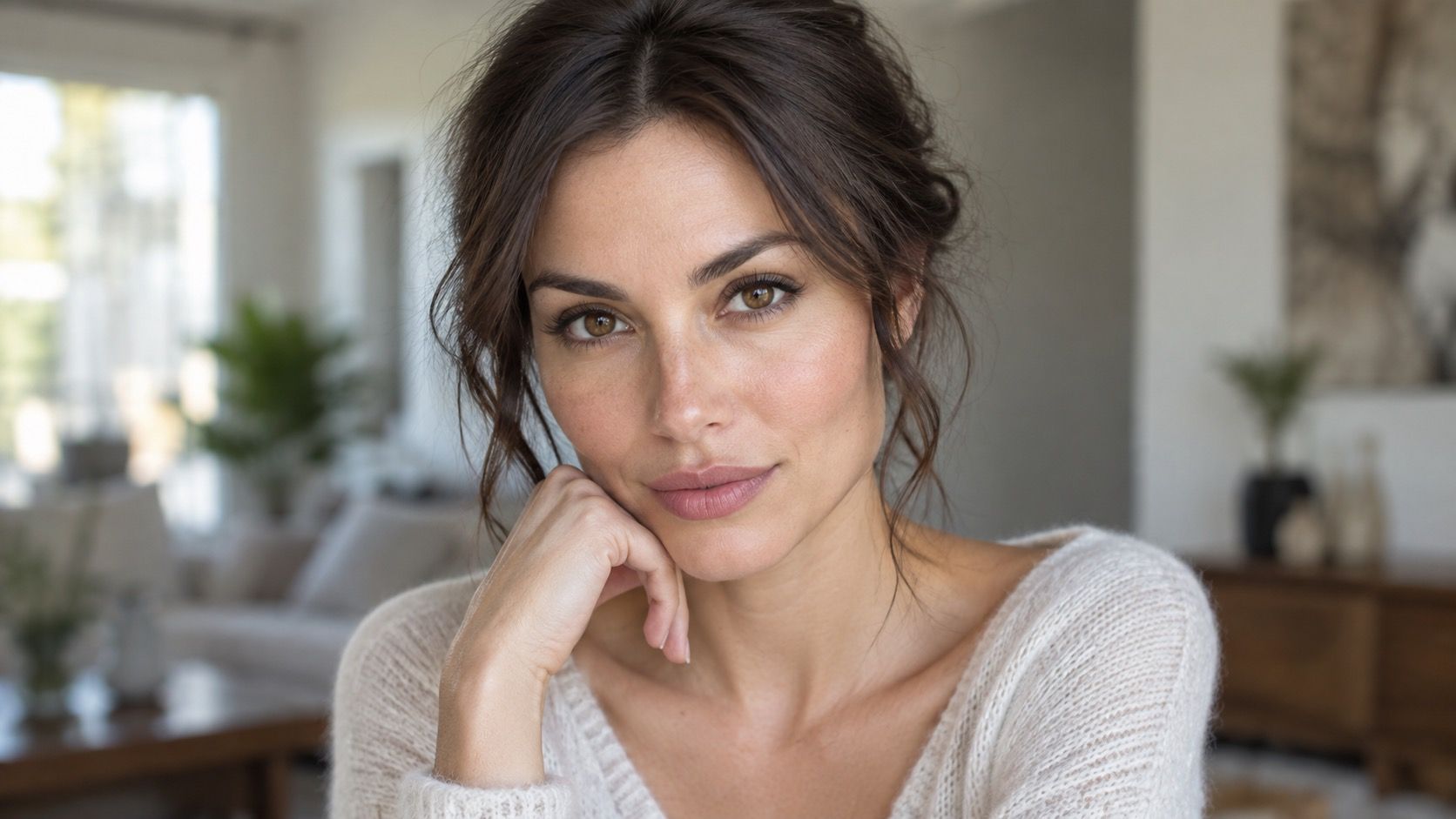
A round face shape is defined less by having full cheeks and more by the way width, length, and curves work together. It often looks nearly as wide as it is long, with soft transitions from the forehead to the cheeks and jaw. The chin is commonly rounded, and the sides of the face do not show strong angles. Seeing the whole outline in neutral light is the best way to tell whether round is a helpful description for you.
What makes a face look round
Round faces usually have a gentle, curved outline. The cheek area can be the widest point, but the forehead and jaw are often fairly close in width. Instead of a sharply tapered chin or a jaw with distinct corners, the lower face sweeps inward softly. Face length is generally similar to face width, although it does not need to be identical.
Cheek fullness alone is not enough to identify a round face. Anyone can have fuller cheeks, especially when smiling, while still having an oval, square, or heart-shaped outline. Look at the relaxed face from hairline to chin. If the overall shape reads as compact and softly circular rather than long, angular, or strongly tapered, round may fit.
The word round is a description, not a correction project. It does not mean your features lack definition. Many round faces have clear cheekbones, expressive eyes, or a noticeable jaw; the category simply describes how those features connect around the perimeter.
How to check your face shape accurately
Start with a mirror or a photo taken straight on. Pull hair back, use daylight or evenly diffused indoor light, and keep your chin parallel to the floor. A very close phone selfie can make the middle of the face look wider, so place the camera at eye level and step back. Use a neutral expression first, then take a second look while smiling if you want to see how your face changes in motion.
Compare the width of your forehead, cheekbones, and jaw. Then compare the width across your cheekbones with the distance from hairline to chin. With a round face, these dimensions tend to be relatively close, and the jawline and chin remain soft. A piece of string can be easier than a tape measure if you only want a rough comparison.
Do the check more than once. Hair volume, a raised eyebrow, a tilted head, and different lenses can all change a photograph. If the same broad, curved outline appears in a mirror and in a simple photo, the observation is likely more dependable than a result based on one filtered image.
Common round face characteristics
Common clues include soft cheeks, a rounded chin, and a jawline that curves rather than forming a clear corner. The face may look widest through the cheeks, with a forehead and jaw that feel balanced rather than dramatically wider or narrower. The vertical distance from forehead to chin tends to feel compact compared with an oval or oblong face.
None of these features needs to be extreme. A round face can have a slightly higher forehead, a subtle chin, or cheekbones that are easy to see. What matters is the recurring combination. You may also have a mixed result, such as a round cheek area with a more tapered chin. That is common and can be more useful than trying to eliminate every overlap between categories.
Take hairline variation into account without letting it decide the answer. Straight bangs can make the face appear shorter, and big curls at the sides can make it look wider. Move the hair away from the outline for your first check, then bring your usual styling back when you make practical choices.
Round versus oval and square faces
Round and oval faces both have soft edges, but an oval face is visibly longer than it is wide and usually tapers more gently toward the chin. A round face looks more compact through the center, with a similar sense of width and length. If you are deciding between the two, compare the full vertical line from hairline to chin rather than focusing only on the cheeks.
Square faces can have a comparable width, but their jaw and forehead are more angular. A square face often shows a stronger horizontal line at the jaw, while a round face carries the curve through the lower face. A face can have a broad jaw without being square, so pay attention to its corners and not just its measurement.
There is no need to treat one label as permanent. Face shape can read differently with a beard, makeup, weight changes, a new haircut, or simply a different camera. The goal is to notice proportions clearly enough to choose styles with intention.
Haircut ideas for a round face
Haircuts can either emphasize the face's softness or introduce contrast, depending on your preference. Longer layers, a side part, and a little height at the crown can create a more vertical visual line. A lob that falls below the chin, face-framing layers, or waves with volume concentrated above the cheekbones can also change how the overall shape reads.
If you prefer shorter hair, a textured pixie, a side-swept fringe, or a cut with height on top can look polished and easy to style. A blunt chin-length bob can work too, especially if you like a graphic shape, but its exact length and volume make a difference. Ask your stylist to work with your hair texture and daily routine rather than choosing a cut from a chart.
Bangs are a personal choice. Curtain bangs, longer side bangs, and wispy pieces can leave the forehead visually open, while a heavy straight fringe can make the face appear shorter. Neither option is wrong; try the effect you actually enjoy rather than assuming that a face-shape rule should decide for you.
Glasses, makeup, and accessories
Glasses can introduce angles, curves, or an upward lift around the eyes. Rectangular, geometric, and gently upswept frames are often suggested for round faces because they create contrast, but round frames can look equally intentional if they suit your features and personal style. Prioritize comfort, bridge fit, lens width, and how the frame feels when you wear it for more than a few minutes.
With makeup, blush placement and contour are tools for emphasis, not requirements. Placing blush slightly higher on the cheeks and blending outward can create a lifted effect. A light contour at the temples or under the cheekbones can add dimension if you like it. Keep the placement soft enough that it works in daylight as well as in a close-up photo.
Long earrings, angular studs, high necklines, and open collars all change the portrait area around the face. Try combinations in a mirror with your usual hairstyle. The most useful choice is one that feels balanced to you, not one that follows every suggested contrast.
Make the result useful in everyday life
A face-shape result should give you a few reliable observations, not a list of forbidden looks. For a round face, you might note that your cheeks are the widest area, your jaw is curved, and your face length and width are close. Those clues can help you test a new haircut, compare frames, or decide where to place volume.
Keep room for taste. You can choose soft lines because they feel harmonious, or sharper lines because you enjoy the contrast. Hair texture, color, glasses, makeup, and expression all affect the final impression. A round face shape is a useful starting point for experimentation, not a rulebook for your appearance.